


Jason Clarke, Creators on Filming the Murders
SPOILER ALERT: This post contains spoilers for “The Man in the Glass,” the series finale of “Murdaugh: Death in the Family,” now streaming on Hulu.
When it came time for Jason Clarke to finally play out the moment Alex Murdaugh gunned down his wife and son in “Murdaugh: Death in the Family,” he had already listened to and watched countless hours of trial recordings, interview tapes and archival footage of the man pulling the trigger. He had a handle on the animated, colorful man who was always the loudest person in the room.
“He’s got an element of Tony Soprano in him,” Clarke tells Variety. “He’s an entertainer. He’s not the sad clown, he’s the happy clown!”
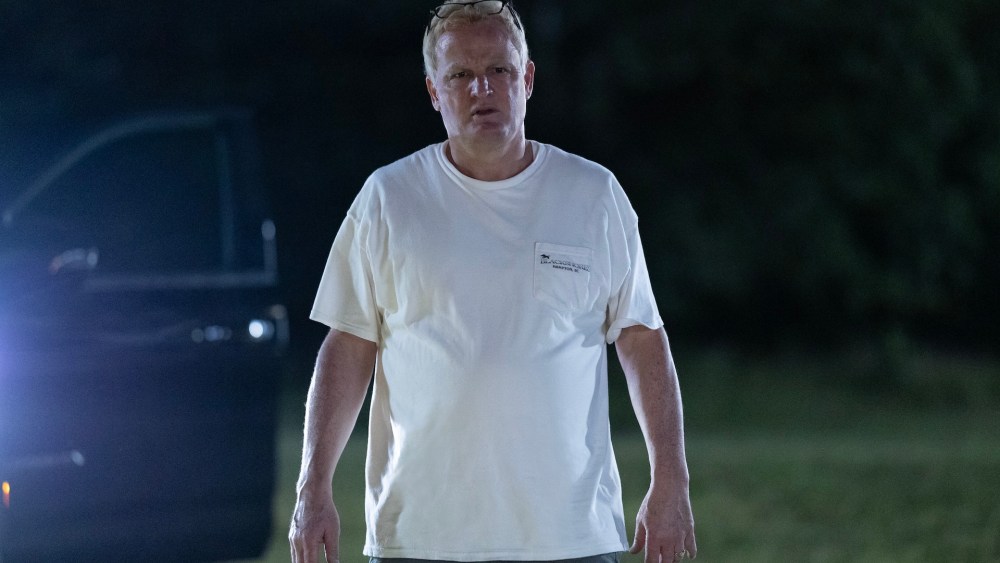
Yet, even though Clarke embodied the showboat lawyer who saw his South Carolina hometown as his stage, with his neighbors as his audience, the moment Alex kills his wife Maggie (Patricia Arquette) and son Paul (Johnny Berchtold) is devoid of any such showy behavior. He’s subdued and calculated. Clarke worked to master that side of him as well in the UCP series.

Courtesy of Disney/Daniel Delgado Jr.
“That’s the lawyer in him going to close, going for the kill,” he says.
The scene originally plays out in Episode 6, without Alex in the picture. But as he lies in his prison cell in the finale, he thinks back to the night of the murders, and the scene retraces its own steps from Alex’s perspective. Before they shot the sequence, Clarke talked extensively with co-creators Michael D. Fuller and Erin Lee Carr, director Steven Piet and the crew on the ground in Atlanta about how the scene should unfold and be shot. They knew the beats they had to hit. The scene starts as a mundane set of chores. Maggie’s dog Bubba walks up with a dead chicken in its mouth, causing a conversation that Paul captured on a Snapchat video that placed Alex at the scene, and ultimately sealed his conviction. After that moment passes, Alex steps away to put on the infamous blue raincoat, grabs two guns, walks up to Paul and shoots him point blank in the chest and then in the head. Then, Maggie comes running, and he shoots her in the leg, the chest and then ultimately twice in the head. It would have happened quickly, and Clarke didn’t want to spend more time in the moment than he needed to either.
“I didn’t really want to do this all night,” he says of filming. “It is not nice pointing a gun at somebody, even another actor in a scene. And there was also the feeling that we get one shot at this, because that’s all he got. It’s messy in its own way, and it’s quick, and then it’s over. We got the feeling of what it was like, and what always struck me was the simplicity of it in the end. We didn’t have a desire to put anything on it that wasn’t really there.”
But it is important and powerful that it’s included in the series at all. After a flurry of documentaries on Netflix, HBO Max, CNN, ABC, NBC and even a two-part Lifetime movie, the tragedy of the Murdaughs, and the casualties they left in their wake, has been dissected relentlessly in the four years since the murders. Yet none of those reports could show, as viscerally as “Death in the Family” does, the murder scene: Alex actually killing his family. It is something that prosecutor Creighton Waters laid out in detail in Alex’s 2023 trial. But seeing it play out with no doubt of his role in it was paramount to Clarke.
“That’s the whole point of doing it,” he says of the series. “That’s the point of picking it up. Waters broke it down in the trial in a legal sense. And then, we, as dramatists, broke it down on screen.”
He also had one request for how it should play out: “It was important to me that Paul and I got to lock eyes, because I think that would have happened, even for a second,” he says.
That moment of realization for Paul — something Arquette also has to play out when Maggie rushes up to see her husband standing over their son’s lifeless body — made the entire filming process a somber affair. “Paul seeing it coming with that second shot, and Maggie seeing her son on the ground and knowing the last person she saw was Alex, is horrible,” Carr says. “It was a very quiet night on set when we filmed that.”
Courtesy of Disney/Wilford Harewood
But for Fuller and Carr, there was also the question of when. When did Alex decide to kill Maggie and Paul? The show can’t answer that, because no one knows. Was it in days or weeks before? Or was it in the moment, as seen in Episode 6, when Maggie tells Alex she doesn’t trust anything he says, or later when he finds mother and son on the porch sharing a tender moment at his expense?
“What we hope these episodes explain is that all these moments could have been when he chose to do it, and Jason plays it so beautifully where he doesn’t give it away,” Carr says.
For Carr, it was the moment when Maggie’s sister Marion (J. Smith Cameron) took the stand and spoke about the premeditation of the crimes that really solidified the timeline. So much so, they put her testimony into the finale.
“The most revealing part in the real-life story was when Marion was on the stand, and said that Alex had told her, ‘I think whoever did this had been thinking about it a long time,’” Carr says.?”That struck her as very odd, and for us, as people who’ve studied it and then dramatized it, that’s what I truly believe.”
The series as a whole also had the mission to give more depth and humanity to Maggie and Paul, who, by the time the country knew about the Murdaughs’ many dark secrets, were already dead and couldn’t speak for themselves. Paul, specifically, was also known for crashing a boat while drunk in 2019 and killing teenager Mallory Beach, a legal situation that only exacerbated Alex’s financial and opiate addiction issues. Fuller, who is from South Carolina, fought to adapt reporter Mandy Matney’s “Murdaugh Murders Podcast” as source material, because he wanted to do right by his home state and the people involved in the story. He also wanted Maggie and Paul to be more than the victims in the photos endlessly circulated by the media, and plastered on posterboards in the courtroom, even if their stories are complicated by questions of complicity and wrongdoing.
“What we wanted to depict with them is that there’s a complexity to them, and that includes the good things, especially in our version of them,” Fuller says. “The grace and guilt, and trying to search for answers.”
One way of doing that was a speculative scene in Episode 6, right before their deaths, which imagines them sharing a heart-to-heart about why it is not their job to save Alex from himself. Maggie had begun the process of leaving Alex, and only came back into town to support him at his request as his father’s health declined. Paul, meanwhile, had started to accept and process his guilt in Mallory’s death, turning toward his family and his future.
“Here may be a path forward where they can really have that mother-son bond or maybe they wouldn’t have, but whatever it would have been, they were deprived of that opportunity,” Fuller says of the scene, which he co-wrote. “It’s a moment of growth. It’s not a full-blown breakthrough. It’s not a moment where everything makes sense now. But it was a chance to ask what could have been if they hadn’t been tragically killed.”
Even though they did want to show the complexity of the Murdaughs’ stories, Carr is clear about how she sees Maggie and Paul.
“From my point of view, they were victims of Alex Murdaugh,” Carr adds. “Whether people have feelings about her being a bad mother, or Paul doing what he did, they were murdered in cold blood.”
If anything about Clarke’s opinion of the case changed over the course of production, he says it is because of the show’s commitment to shedding more light on Alex’s victims.
“I feel like I know the characters of Paul and Maggie more, and that community more,” he says, noting he quietly visited Hampton before filming began. “Two days after Maggie and Paul were killed, [attorney] Mark Tinsley rang Alex up and said that on behalf of the Beaches, they were going to drop the lawsuit against the family. They didn’t think it was right in lieu of what he was going through, and that really broke my heart. But I admire that as well. It is the human thing to do. It made it all more real, and I cared about everyone more.”
Clarke still talks in great detail about the case, the trial and his thoughts on the firestorm around the story. If you ask him, he will tell you what mistakes he thinks the defense made in the trial, what shouldn’t have been admitted in the case and what parts of Alex’s testimony on the stand he would have liked to play out in the show. It is clear he isn’t exaggerating when he says he did his homework. While he never wanted to mimic the man completely, he did want to give those who knew the case and felt like they knew Alex something recognizable to latch onto, especially in the finale when Alex takes the stand in his own defense.
“We crafted that out to do exactly as he did because it was such a very particular kick off to his self defense,” Clarke says. “He did lean back at that moment, and smacked his lips at another. We tried to time out when he looked at Buster in the audience because he clocks Buster at a very strange time within that. But you come back to it because people have seen this trial and these videos so many times. I’m a big believer that if you hit certain stuff, people will lean more into the stuff we are taking a stab at, for lack of a better word.”
He took pride in hearing, directly from Matney herself, that someone who knew the real Alex thought they might have taken him out of prison to play himself because Clarke was doing such a good job. But one thing from that immersion in the world of the Murdaughs has stuck with him: The Murdaugh men’s practice of constantly calling everyone “bo” has seeped into the Australian’s own vocabulary since filming, much to the chagrin of people like his son.
“My family came with me when we were shooting, and my son just said, ‘Daddy, can you stop saying that, please? I don’t like it.’ Clarke says with a laugh. “I’m out here in Australia right now, and the other day I called a guy ‘bo.’ It’s like ‘mate’ to us, but he just looked at me so confused. I still love that term, I really do.”
