


A Fresh Perspective on the War in Ukraine
They’re referred to only as “the hat-wearers”: an isolated, peaceable community of staunchly traditionalist Christians living on the banks of the Dniester River in western Ukraine, so austerely modest in their principles that they don’t even give themselves a name. Add it to the long list of things they’re content to live without, from electricity to motorized vehicles to a physical church. (Indeed, the colorful caps and headscarves they’re required to wear seem an atypically indulgent detail by comparison.) But while living in strenuous isolation from modern life has its benefits in times of war, the shockwaves running through Ukraine since Russia’s 2022 invasion must ultimately reach the hat-wearers too — and the resulting tensions between past and present, between isolation and solidarity, are sensitively probed in Dmytro Sukholytkyy-Sobchuk‘s remarkable documentary “Silent Flood.”
Premiering in the international competition at IDFA — where it deservedly took a prize for its immaculately composed cinematography — Sukholytkyy-Sobchuk’s second feature (following his Cannes-premiered fiction debut “Pamfir”) is just one of many recent docs set against the backdrop of the invasion, whether directly combat-oriented (as in Mstyslav Chernov’s Sundance winner “2000 Meters from Andriivka”) or concerned with everyday life amid the turmoil (as in Kateryna Gornostai’s Berlin competition entry “Timestamp”).
However urgent and timely the subject, it’s increasingly a challenge for new documentaries to assert an unfamiliar perspective on the war — though “Silent Flood,” with its focus on Ukrainians staying expressly away from the fray, manages the feat. Extensive further festival play is a given, but specialist nonfiction distributors will be drawn to the film’s wry human interest and considerable visual beauty, best served by theatrical exhibition.
Shorn of context, you’d be forgiven for not knowing exactly when or where “Silent Flood” is set for much of its running time. Such is the extent to which the community under scrutiny — who share ancestors with the Amish, they say, though the groups split somewhere along the way — have separated themselves practically, culturally and politically from contemporary ways of living. Day after day, they manually plow their fields, wash their clothes in the river, cook their produce over hot coals, and eat by candlelight on hand-carved furniture.
The camera observes such daily routines at fairly intimate quarters, though its presence is never acknowledged by the people on screen. All voiceover in the film is detached from the images, from a mixture of unidentified community folk who are content to speak anonymously, and neighboring outsiders perplexed by these out-of-time pacifists. From the latter camp, a strain of bitterness enters their commentary when the war comes up: One woman suggests the hat-wearers are hypocrites for refusing to join the army even as they use public services for which ordinary taxpayers have labored. Her complaint is countered by a quote from the opposite side: “We live under God, so there’s no need to defend the country.”
The film takes no side in this ideological argument, though the second of its three chapters — simply titled “Bread” — brings the matter to a suitably Christian compromise: The hat-wearers won’t join the fight, but they will gladly bake large, hearty loaves to send to the soldiers on the front line, a gesture of solidarity compliant with their belief that “the Bible says to be content with bread and clothes.”
In the final chapter, “Echoes of War,” the focus finally shifts to those soldiers, shown bunkered down by candlelight in a painterly shot that pointedly mirrors an earlier dinnertime scene in a hat-wearer’s dim kitchen. “Sure, they’re peculiar, but I’d like to thank them — they’re contributing too,” says one. Earlier, we hear elders reflecting on the lives and homes that were lost when the river burst its banks in the early 1940s, while the rest of the world was at war; as the title suggests, the region is once more facing some manner of disaster beyond their control.
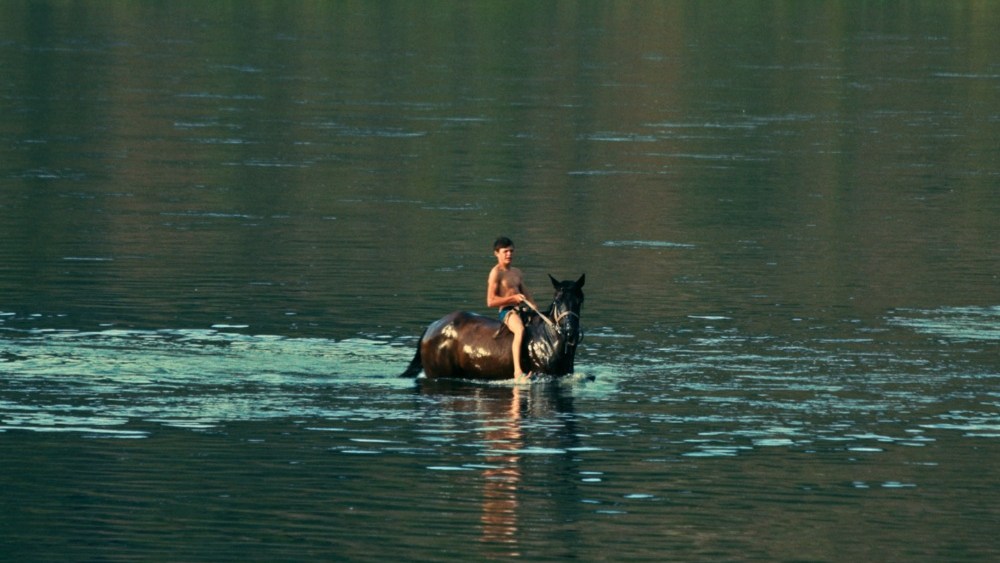
Sukholytkyy-Sobchuk’s own commentary works with tacit eloquence through such parallels and contrasts. No man, we are shown, is entirely an island, and the uncertainty of Ukraine’s future hangs over the hat-wearers too — particularly a young generation that may not always have the option of living quite so independently of the outside world. Many of the most enchanting images and sequences in “Silent Flood” watch the children of the community at play: riding horses through the river on a humid summer afternoon, skating on those same frozen waters at midwinter magic hour, or rolling a toy truck down a bumpy dirt track — just one omen, perhaps, of modern intrusions to come.
