


Stunt Legends Speak at Round Top Film Festival
Airbags are fine. But when it comes to high falls, sometimes all you need to land safely is a stack of cardboard boxes.
That was one of the takeaways from the Round Top Film Festival’s “From the Jump: Film and TV Stunt Designers in Conversation” panel in Round Top, Texas on Nov. 9, which featured veteran stunt coordinators and second unit directors Chris O’Hara, recipient of the fest’s Maverick Stunt Award, and Vic Armstrong, who was honored with a Lifetime Achievement Award.
“You can tuck a cardboard box into the little corner over there [if] he’s coming off that deck and landing in the alleyway,” said Armstrong. “You get an airbag, you can’t fit it in there.”
“If you hit the edge of an airbag, it’s not good. … You’re going to roll right off to the ground,” added O’Hara. “You can hit the edge of boxes, if you set them up correctly, and it will still kind of slow your fall down and do what it’s supposed to. … The general rule of thumb is one two-foot-by-two-foot box is good for 10 feet [of height].”
The panel also featured Nate Boyer (former Army Green Beret and NFL player turned filmmaker), Shane Habberstad (stunt person, stunt coordinator and second unit director), Crystal Hooks (motorsports expert and precision driver), Noelle Therese Mulligan (stunt person) and Tom Struthers (stunt coordinator and second unit director). It was moderated by Variety editor Todd Longwell.
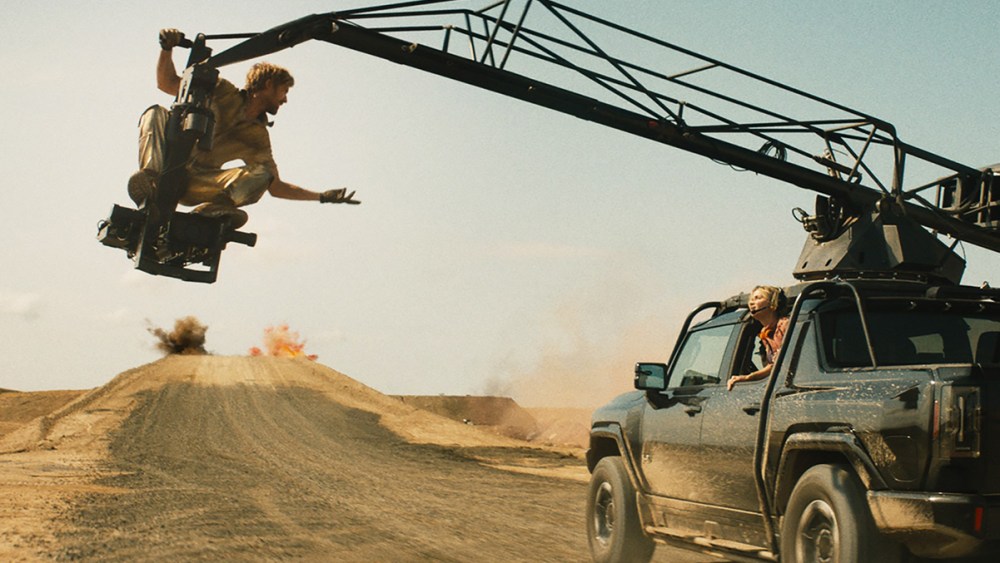
Prior to the panel, O’Hara was honored with the Maverick Stunt Award, presented by Variety. A 25-year industry vet, he earned a Taurus World Stunt Award for best second unit director/stunt coordinator for his work on 2024’s “The Fall Guy,” an action-comedy about a stunt man (Ryan Gosling) who goes in search of a missing movie star. The presentation was made by last year’s Maverick Stunt Award recipient, RJ Casey (“Inception,” “Dunkirk,” “Extraction 2”).
“‘The Fall Guy’ just crushed it,” enthused Casey. “It’s one of those movies that you just can’t turn off because you can’t wait to see the next sequence, the next stunt. … Everything about that movie was magical.”
He went on to praise O’Hara for his efforts to establish a new Academy Award for stunt design, which will debut in 2028: “A lot of generations of stunt people that have made it possible to get stunts into the Oscars finally, and here’s one of the last guys to get that ball into the end zone.”
On “The Fall Guy,” O’Hara and his stunt team broke a Guinness World Record with an eight-and-a-half-turn car roll, executed by stunt driver Logan Holladay, doubling for Gosling. It bested the previous mark of seven rolls set by Adam Kirley in “Casino Royale.”
“I personally didn’t get into this business to break world records. That’s not my goal,” said O’Hara, noting that the number of rolls was written into the script. “I said, ‘If we can achieve it, that would be amazing.’ But I think that on Bond it had the terrain to help it out, to give the rolls. It was downhill so it created more energy for it to keep going. We had to do ours on a beach on flat [ground], so I wasn’t sure if it’d be able to be achieved. … We tested two times on the beach, we shot it once. It didn’t go according to plan. Everybody was safe, but it wasn’t the effect that we were looking for and we had a chance to do another one. So that last one that you see on film was everything coming together.”
The stunt was a “cannon roll,” which uses a pyrotechnic or, in this case, pneumatic device mounted under the chassis, usually near the rear axle. When triggered, it fires into the ground, flipping the vehicle. According to O’Hara, the beach setting for the stunt was a subtle nod to the first on-screen cannon roll, performed by driver Gary McClarty in a climactic beach chase sequence in the 1974 detective movie “McQ,” starring John Wayne.
The cannon roll was developed for “McQ” by stunt coordinator Hal Needham (who went on to direct the first meta stunt movie, 1978’s “Hooper,” starring Burt Reynolds) and stuntman Ronnie Rondell. It was an improvement on the less spectacular ramp flip, in which a vehicle is driven on to hidden, angled ramp and rolled – a technique used since the earliest days of film.
Lifetime Achievement Award honoree Armstrong is a 60-year stunt veteran whose credits include doubling Christopher Reeve in “Superman” (1978) and Harrison Ford in “Raiders of the Lost Ark” (1981), along with second unit director gigs on a long list of films, including a trio of James Bond movies, “Tomorrow Never Dies” (1997), “The World Is Not Enough” (1999) and “Die Another Day” (2002). He’s also responsible for an advancement in stunt technology, earning an Academy Award for technical achievement in 1986 for his Fan Descender, a device that uses air resistance to control a stunt performer’s high fall descent speed.
In recent years, much of the new technology used in the stunt realm has come courtesy of visual effects artists, who employ CGI to erase safety wires, composite in dangerous elements like fireballs and, at times, build action sequences almost completely from the whole digital cloth.
“I have this love-hate relationship with visual effects,” said Armstrong. “I always equate it to morphine. Morphine in the right dose for the right ailment is an absolute godsend. Used and abused, it’s a killer. And I feel the same way with visual effects. Used in the right way, it’s terrific.”
Struthers concurred, but noted that while at times he’s fought against using too much CGI, there are a few stunts where he would’ve been wise to ask for more help from the visual effect department, most notably an aerial sequence in 2012’s ‘The Dark Knight Rises’” in which he had stunt men entering and exiting a plane flying at 6,500 feet.
“If I was given that opportunity again, I’d probably do a lot of that digital because of the element of danger of four people [jumping] out the back of a C-130 aircraft at 120 knots,” he said. “I don’t think I would want to have the same heart attack that I had then.”
It’s impossible to have an entertainment industry discussion in 2025 without talking about AI. While many regard it as a digital bogeyman that will usher in he end of times, when the subject was broached during the stunt panel, the reaction was surprisingly sanguine.
“At a certain point, there’s not going to be a reason to hit a guy with a car,” said Habberstad, a second-generation stunt pro whose bio notes that he was conceived on a movie set. “There already [are] very few reasons. It has to be a very specific thing to do certain stunts where people can get hurt. And I think at a certain point if the computer can do it better and I don’t have to ask my friend to stand in front of a car, then we’re not going to.”
Variety moderated this conversation in partnership with Round Top Film Festival.
